![[Bad]Influencers](https://smartmag.theme-sphere.com/news-time/wp-content/uploads/sites/28/2022/03/logo-Newstime-01-white.png)
![[Bad]Influencers](https://www.bad-influencers.com/wp-content/uploads/2026/06/badin2.png)



Warning: Episode Spoilers Below
Vikings is a series that’s never been shy about killing off its characters, with a nearly Game of Thrones-level of nonchalance. This week was no exception, and while the fate of King Ragnar Lothbrok (Travis Frimmel) has long been expected by fans of the History Channel’s first scripted series, there had always been the hope that the series writer Michael Hirst would give us more time. Now that time has come to an end.

The series started with Ragnar, with his vision of leading the ships across the sea to the lands beyond, of becoming King, and of bringing his people together. He was the center around which all of the other major characters and plotlines flowed – his first wife and fierce shieldmaiden Lagertha (Katheryn Winnick), his brother Rollo (Clive Standen), the shipbuilder Floki (Gustaf Skarsgård), his second wife Aslaug (Alyssa Sutherland), his various sons and dozens of other supporting characters. While those threads would go off on their own adventures, they would always come back to Ragnar.
In a recent interview with EW, Fimmel mentioned, “I was meant to die at the end of the first year, but I wound up staying around for three more!” So in the end we should be happy for the time we wound up with.
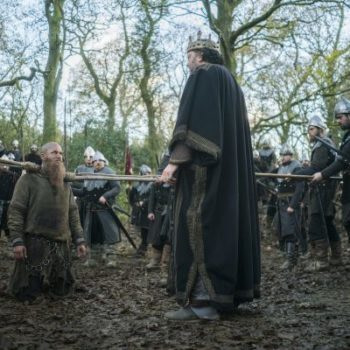
This episode centers around Ragnar’s transfer from being King Ecbert’s prisoner to King Aelle. In the last episode Ragnar made a deal with Ecbert to transfer him to Alle, where he knows he will be executed. In exchange for letting his son, Ivar, return home, Ragnar will instruct Ivar to tell his other sons that his execution was the sole fault of Aelle. Ecbert agreed, since it would save his kingdom from the certain retribution that would be coming from the Northmen. When Ragnar says his goodbyes to Ivar, he tells him to bring his sons back, and bring vengeance on Ecbert and his kingdom, effectively double crossing the king.
In both war and in peace, Ragnar and Ecbert have always been fascinated by each other and Ecbert especially holds Ragnar in a near mythic reverence. The episode moves along at the pace of the cart carrying Ragnar in his cage, but not in a bad way. We get to feel the increasing weight of certainty that we know where this is going to end. Ragnar has gotten his way out of tight scraps before, but this one innately feels different. There is a moment where he thinks that he may yet get out, since the seer had long ago giving his prophesy, “you will die on the day the blind man sees you.” Then he has a vision where his coachman changes into the seer who says, “perhaps I was wrong”.
The various memories which play across Ragnar’s mind as they travel show how far Ragnar has come, and how much weight he has had to carry along the way. By the time we reach King Alle and his troops, and they begin to torture Ragnar, we know that it’s time.
The morning of the execution, Ragnar gives a speech, declaring his being ready to meet Odin and to drink in Valhalla. His anger and strength bubbling over from a figure who a few moments before had just been a shivering heap in his hanging cage. It wasn’t a speech for himself, instead it was a message for the army watching him, and for his sons. It would send a message that he would not be broken.

Ella stands and replies with a prayer, at the end of which the cage opens and he falls, wordlessly, into a deep pit filled with snakes. It takes only a few moments for them to start biting and constricting. The blue fades out of his eyes as they close.

The real-life Ragnar (yes, with full acknowledgement that he’s a pseudo-historical figure, so let’s just go with Ragnarssona þáttr, since that’s the main attestation to his demise) was said to have been killed by King Ælla had him thrown into a pit of snakes, and since it is the History Channel they have done a fair job of keeping one foot in the histories (insofar as they exist anyway).
In the original Old Norse his ending reads:
Varð hann um síðir handtekinn ok settr í einn ormgarð, ok vildu ormarnir ekki koma nær honum. Ella konungr sá, at hann bitu eigi járn um daginn, er þeir börðust, ok nú vildu eigi ormarnir granda honum. Þá lét hann fletta af honum klæði þat, er hann hafði yst haft um daginn, ok þegar hengu ormarnir á honum alla vega, ok lét hann þar líf sitt með miklum hraustleik.
Which in English translates to:
Finally he was taken captive and put in a snake-pit, but the snakes wouldn’t come near him. King Ella had seen during the day, as they fought, that iron didn’t bite him, and now the snakes won’t harm him. So he had him stripped of the clothes that he’d been wearing on the day, and at once snakes were hanging off him on all sides, and he left his life there with much courage.
Hirst has spoken about how the series is intended to be a generational one, and not just about Ragnar, which is why there have been multi-year time jumps before to be able to move forward to the time when his sons are old enough to set out onto their own voyages of conquest. Now, with the impetus of the loss of their father, they can set out both for revenge as well as to explore the other lands (they do have a map to the kingdoms around the Mediterranean, which for them really is more of a to-do list).
